
Calhoun County Owner of Record
The Revenue Commission keeps the assessment roll for roughly 70,000 parcels. Its public tax and GIS system is the quickest way to tie a current owner to an address. The owner of record is simply the name on the official roll or instrument. It says nothing about who lives there. And it can lag behind a freshly recorded transfer.
| Owner Name | The legal name associated with the assessment account |
|---|---|
| Mailing Address | Where Revenue sends tax correspondence |
| Situs Address | The physical location used for the parcel search |
| Parcel / PPIN | The key that separates the land from same-name results |
| Deed Reference | The last deed book and page when displayed |
The listed owner might be an individual, an LLC, a trust, an estate, or several co-owners at once. Revenue's published field model also carries acres, city, ZIP, tax district, land use, total value, and the land, improvement, and assessed values. Field labels on a live parcel result can vary, so rely on the model rather than any assumed column.
Separate Calhoun Owner Addresses
Alabama's homestead form splits the physical address from the mailing address and asks for the deed book and page. The situs address locates the land itself. The mailing address routes county correspondence, and it may point to another county, a post-office box, a mortgage company, or another recipient entirely. Neither address proves anyone occupies the property.
- Assessment roll
- The Revenue record used to classify and value parcels.
- Situs
- The physical location used by GIS and 911.
- Recording lag
- The gap between a deed recording and a later update in another system.
- Owner of record
- The name currently attached to the roll or deed being checked.
Revenue asks owners to report ownership changes, new mailing addresses, and improvements. Match the APN and legal description before deciding two records describe one tract.
How Current Is Calhoun Ownership
Calhoun County says its online mapping and tax data update monthly. The web view may trail in-house map changes. That cadence is not a fixed deed-to-roll delay. The county also warns that a tax bill can stay in the previous owner's name. That can happen after a purchase. When timing matters, read the date on the newest deed. Ask Revenue whether the office record differs from the web view. A tax year control can pull up a prior period. Confirm the year before trusting any name as current.
Recent sale. The roll can lag a transfer. The newest recorded deed provides the more current paper trail when the parcel and legal description match.
Confirm the Current Calhoun Owner
Confirmation runs from the tax parcel to the latest conveyance. Start with an address search in the Calhoun tax portal. Write down the exact name, parcel string, and deed reference. Then use the Recording Division terminal. Or ask staff to pull the newest deed for that land.
- Pull the current tax parcel by address or full APN.
- Save the owner spelling and last deed book and page shown.
- Locate the newest matching deed in the Probate Record Room.
- Verify its grantee, legal description, and recording details against the parcel.
- Grantee
- The party receiving the interest in a deed.
- Vesting
- The way the deed states that ownership is held.
- Registered agent
- The official contact named in a business filing, not necessarily the landowner.
The Record Room has five terminals, first come, from 8:00 a.m. to 4:30 p.m. weekdays. The county publishes no public online deed index. If the deed and Revenue roll disagree, ask both offices about the exact parcel.
Read the Newest Calhoun Deed
The Calhoun County Probate Judge records deeds, mortgages, liens, judgments, easements, plats, assignments, and lis pendens. Bring the APN and legal description so you don't grab a deed from a same-name match. The official Probate page describes the Recording Division and the public Record Room.
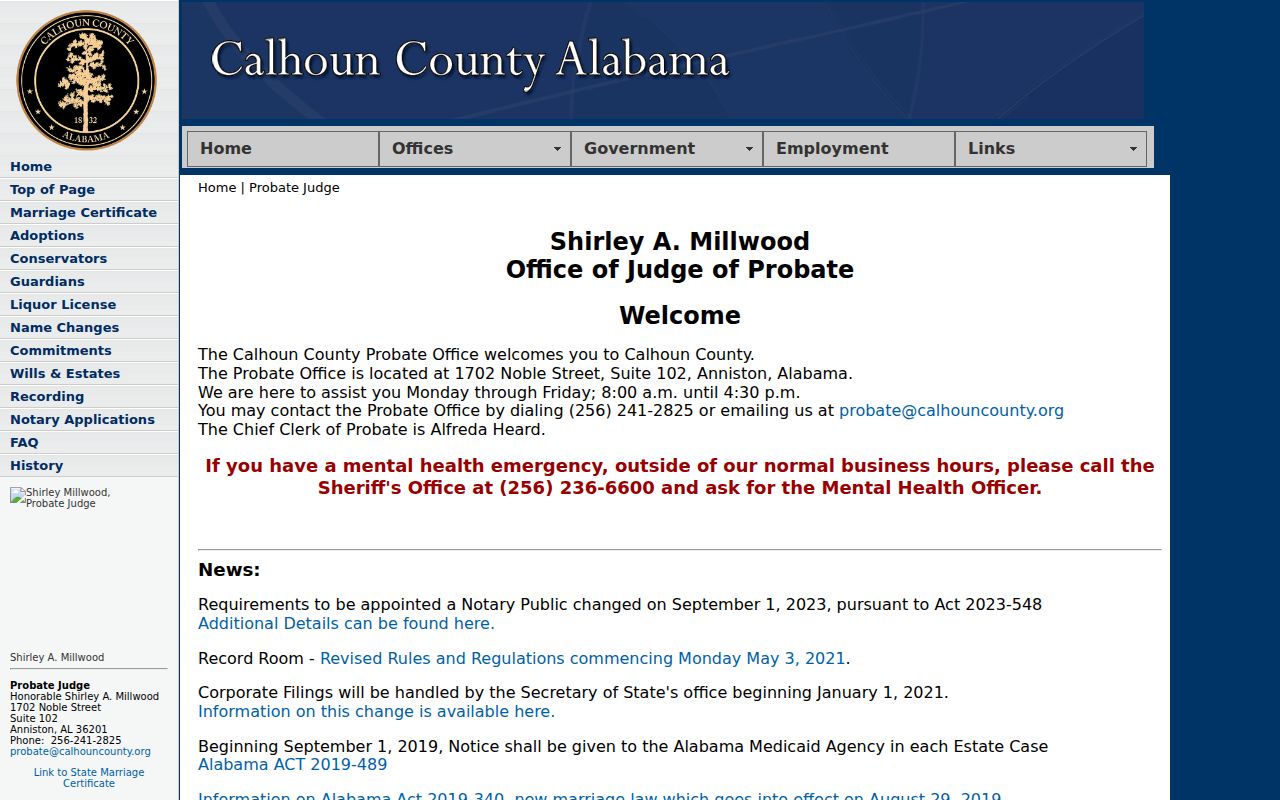
This office record settles the question when the online owner looks stale. Plain copies run $1 per page, and certification costs $3 per document.
Calhoun Entity and Estate Owners
An owner field can carry an LLC's exact legal name. Trust land may appear under a trustee or trust style. Estate land can involve a will and an administration file. It can also involve an executor or administrator deed. A court order or a later heir deed may follow. Never swap the legal grantee for a guessed individual. The Alabama entity search confirms an entity's name, number, status, and filing parties. Those filings add context, but only the deed connects the entity to the land. For estate questions, ask Probate for the estate file and the recorded transfer. Note: A company officer, trustee, or executor is not automatically the personal owner. The same goes for a mailing recipient of the Calhoun County parcel.
Update a Calhoun Current Owner Record
Calhoun Revenue tells a new owner to record the deed and assess the property. Owners should also report a wrong detail to the right Revenue unit. That includes a wrong mailing address, ownership entry, or improvement item. Appraisal handles the property card and value work. Assessing handles ownership, mailing addresses, tax classification, homestead, and current-use matters.
When you report a mismatch, bring the right keys. These are the deed book and page, parcel number, physical address, and the exact legal owner name. The Assessing office sits at 256-241-2855. It will not give parcel numbers or property values over the phone. So pull those keys online, at the counter, or through the county's $2-per-parcel mail research route.
A Revenue correction never rewrites a deed. Recording a deed, in turn, does not guarantee an instant web update. Keep proof of the recorded instrument. Then check the public roll later if the ownership display affects a tax notice or another county process.
Use Calhoun Owner Data Lawfully
A mailing address on the roll is the county's correspondence route. It may not match the property, and the owner may not live there. Keep any contact tied to a lawful property matter, such as a boundary question, a deed correction, or a genuine transaction inquiry.
Lawful use. Public access never permits harassment, threats, trespass, impersonation, or misuse of protected details. Some addresses can be withheld under specific confidentiality rules.
For the wider method, start with the Calhoun County property owner lookup. A contested title needs the recorded instruments themselves, plus legal advice or a court ruling when the ownership dispute runs deeper.