
Trace Calhoun County Former Owners
Build a backward chain from real entries, never a guessed list of names. Every date and party must come from an actual recorded deed. The Probate Judge records each deed. The Revenue office supplies the starting parcel and often a last deed reference. Those two offices anchor the whole property search.
| Source | Years It Covers | Where Held | What It Shows |
|---|---|---|---|
| Recorded deeds | Exact run not posted | Probate Record Room | Grantor, grantee, land and deed reference |
| Older deed books | Exact run not posted | Probate and library fallback | Earlier conveyances and legal descriptions |
| Recorded plats | Current and historic | Probate | Subdivision, lot, block and changed parcel context |
| Local microfilm | Newspapers described from 1827 | Alabama Room | Deed, mortgage, court and local-history context |
Start with the newest deed, whatever the era. That deed gives you a verified former owner. It also supplies the legal description that anchors every earlier link. Work backward until the office index stops, then continue through deed books, plats, microfilm, and any linked estate or court files.
Search Calhoun's Probate Record Room
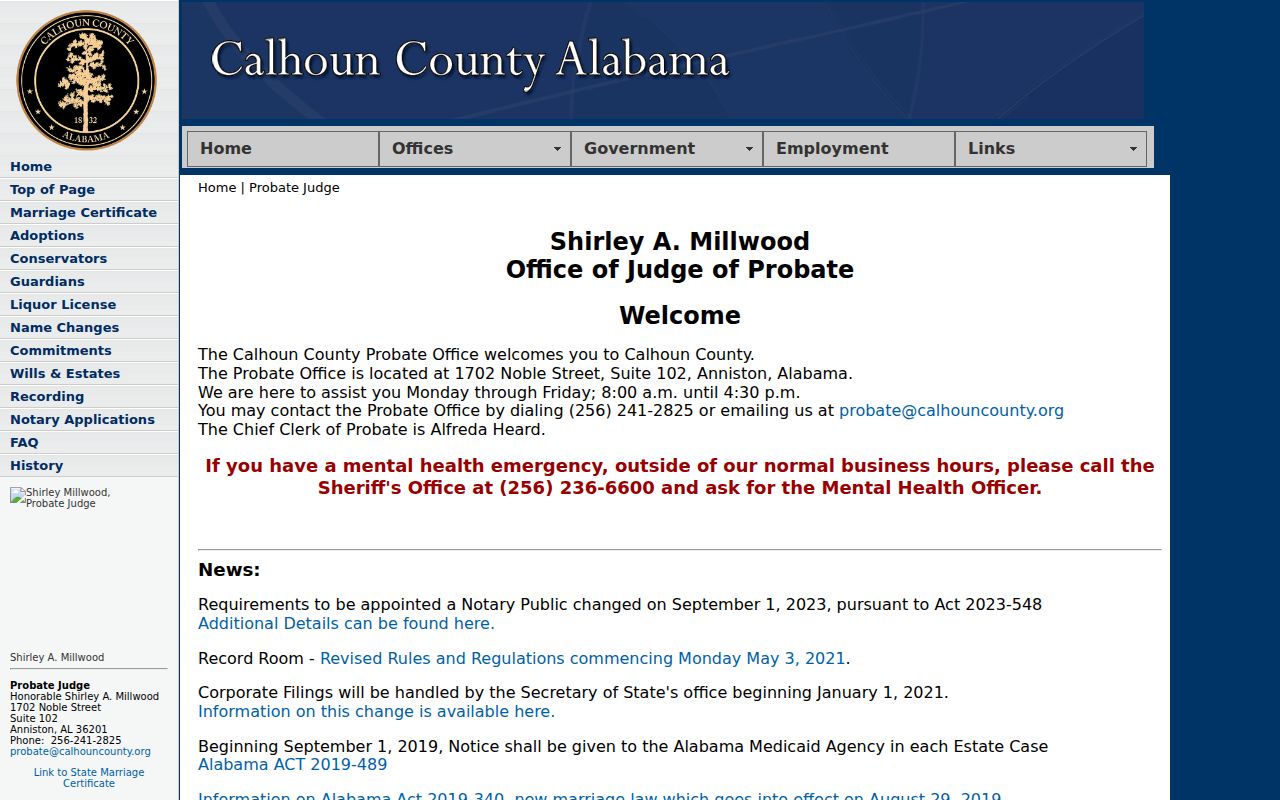
The Probate Recording Division offers five public terminals. Access is first come, first served, weekdays from 8:00 a.m. to 4:30 p.m. Bring the current owner of record, the parcel number, the legal description, and the last deed book and page. The office publishes no online deed-index form. Recording details come from the official Probate page.
Search both sides of every transfer. Check initials, spouses, entities, estates, and alternate spellings as you go. A plain copy costs $1 per page, and certification costs $3 per document. Certifying every deed is rarely necessary.
Unknown cutoff. Calhoun County has not published a verified earliest online deed year. Use the Record Room and books instead of assuming one.
Reach Older Calhoun Ownership Records
The Alabama Room holds more than 10,000 microfilm rolls and 11,000 printed volumes, along with deeds, mortgages, early Circuit Court material, maps, and family files. Local newspapers date from 1827 forward. These sources support house history when a deed-book reference needs context. Calhoun's seat moved to Anniston in 1899. Older records may still point to Jacksonville. Today's offices sit in Anniston. That is a search clue, not proof of record loss. No courthouse fire or missing deed run is documented.
Read Calhoun's Deed Chain Backward
Move backward through the same tract, transfer by transfer. The legal description, subdivision lot and block, plat book, or section-township-range text links deeds more safely than any street address.
- Find the current deed and copy its grantor, grantee, legal description, and reference.
- Search that grantor as a prior grantee to find the acquisition deed.
- Compare the land text, then repeat with the next earlier grantor.
- Bridge an estate or court event with the linked case file and later recorded deed.
- Grantor
- The party conveying an interest.
- Grantee
- The party receiving it.
- Chain of title
- The linked sequence of deeds for the same land.
- Reverse index
- An index organized by grantor.
- Quitclaim
- A deed conveying the grantor's interest without warranty-deed assurances.
Parcel splits and street changes break name-only trails fast. Return to the recorded legal description instead of forcing an old parcel number onto a new tract of land.
Bridge Calhoun Estate Owners
A death transfer can involve a will, an administration, an executor or administrator deed, a decree, an affidavit, or a later deed from heirs. The tax roll may lag behind. Search Revenue first. Check the last recorded deed next. Then ask Probate for the decedent's estate file and any recorded transfer from heirs. A will should be probated within five years, and an inventory is required within 60 days of appointment. Those deadlines never prove a parcel passed through an estate. The case file and recorded instruments do.
Follow Calhoun Plats and Names
Historic addresses make weak chain keys. Anniston was once Woodstock. Jacksonville was Drayton, and Calhoun County began as Benton County. A deed may instead describe land by subdivision. It may use lot and block. Or it may rely on section, township, and range.
Use the plat reference when parcels change. GIS orients today's parcel, but its polygons are tax data, not a survey. The legal description and recorded plat keep former owners tied to the land itself.
Note: Never assume a modern street address existed in the same form throughout a Calhoun County ownership chain.
Check Calhoun Court Transfers
Some former owners exit the chain through foreclosure, partition, quiet title, a sheriff sale, or another court order. Search the deed first. Look for a case number, a lis pendens reference, a commissioner or sheriff grantee, or any court-directed party. The recorded instrument often points straight to the court file that explains the event.
The Calhoun Circuit Clerk offers a public terminal. A written request can identify the case number, party names, style, aliases, case type, and requested filings. Archived or microfilmed searching is listed at $25. Copies up to 20 pages cost $5. Additional pages run $0.50 each, and clerk certification costs $5. Ask for the complaint, the order, the sale papers, and the recorded follow-up deed that matter to the chain.
A docket index is never the whole transfer. Match order and deed to one legal description. Probate estate files play a similar role when a former owner died before the next recorded conveyance.
Limits of Calhoun Ownership History
Any previous-owner timeline is only as complete as the deeds found and matched correctly. Gaps come from unrecorded interests, index variants, estates, changed descriptions, and court orders. The first deed-book year is not published. No fixed end date can be stated.
Lawful use. Former-owner research supports house history and property diligence. It never permits stalking, threats, trespass, or harassment.
Ownership history has limits. This work is not a title opinion. A disputed interest may call for a qualified examiner, attorney, or court. For copying a located instrument, the Calhoun County deed records resource explains the process.
Keep a log as the chain grows. Note each spelling tried, deed type, date, book and page, and legal description. Explain why each match was accepted. Mark uncertain links clearly rather than listing them as former owners. A later correction deed, release, or court order can point back to an earlier volume. That can resolve an apparent break. Shared names are common. Acreage, subdivision lots, adjoining owners, and spouse or entity names help tell people apart. That discipline keeps the backward chain tied to one Calhoun County property. It also keeps the chain tied to its true deed records.