
Read Calhoun County Property Tax Records
Revenue Appraisal estimates fair market value and keeps the property card current. Assessing then applies the statutory class and any exemptions to that value. Collections issues the bill and receives the payment. Each office leaves its own mark. That is why a single Calhoun County tax record shows several value terms side by side.
The bill itself is an annual obligation. It is not a sale appraisal, and it is not a title opinion.
| Field | What It Shows | Where |
|---|---|---|
| Appraised value | Revenue's fair-market estimate for land and improvements. | Appraisal card |
| Assessed value | Appraised value multiplied by the property class ratio. | Assessment |
| Exemptions | Approved relief that can lower the taxable amount. | Assessing |
| Tax bill and status | Annual amount, payment, or delinquency. | Collections |
| Tax district | State, county, school, city, and fire levy context. | Tax record |
Alabama sets the ratios by class. Utilities pay on 30 percent of value, business property on 20 percent, and Class III land, covering agricultural, forest, owner-occupied residential, and historic property, on 10 percent. A class change moves assessed value even when appraised value holds still.
Look Up a Calhoun County Tax Bill
The portal offers owner, location, property number, and bill searches. Each mode carries its own roll and year controls. Pick one mode at a time. Enter names last-name first, and a street-only search can return a whole block. Parcel mode works best when you hold the exact APN.
- Choose one search key, roll type, and tax year.
- Match the APN and address.
- Read the bill and status.
- Compare class, value components, and exemptions.
- Assessed value
- Appraised value after the class ratio.
- Mill
- One tax dollar per $1,000 assessed.
- Homestead exemption
- Qualified owner-occupied relief.
- Tax lien
- A statutory claim from unpaid tax.
Appeal a Calhoun County Assessment
Start by talking with Revenue staff. For a formal challenge, a Board of Equalization hearing request must reach the county within 30 days of the valuation notice. The form asks for the parcel, owner, address, appraised value, the value you claim, purchase facts, improvements or destruction, comparable sales, photos, maps, surveys, and other support.
Appeal window. File within 30 days of the valuation notice and keep proof of timely delivery.
Track Calhoun County Property Tax Dates
Tax comes due October 1 and stays penalty-free through December 31. The account turns delinquent January 1, when interest begins at one percent per month. Delinquent property is advertised in April. The tax-lien auction follows in May. Certified funds are required after April 2. Check the live account and the notices themselves. A delinquent label alone does not prove a sale or redemption has run its course.
Search Calhoun County Tax Fields
The county property tax form lays out all four lookup modes on one screen, with year and roll controls you confirm before searching.
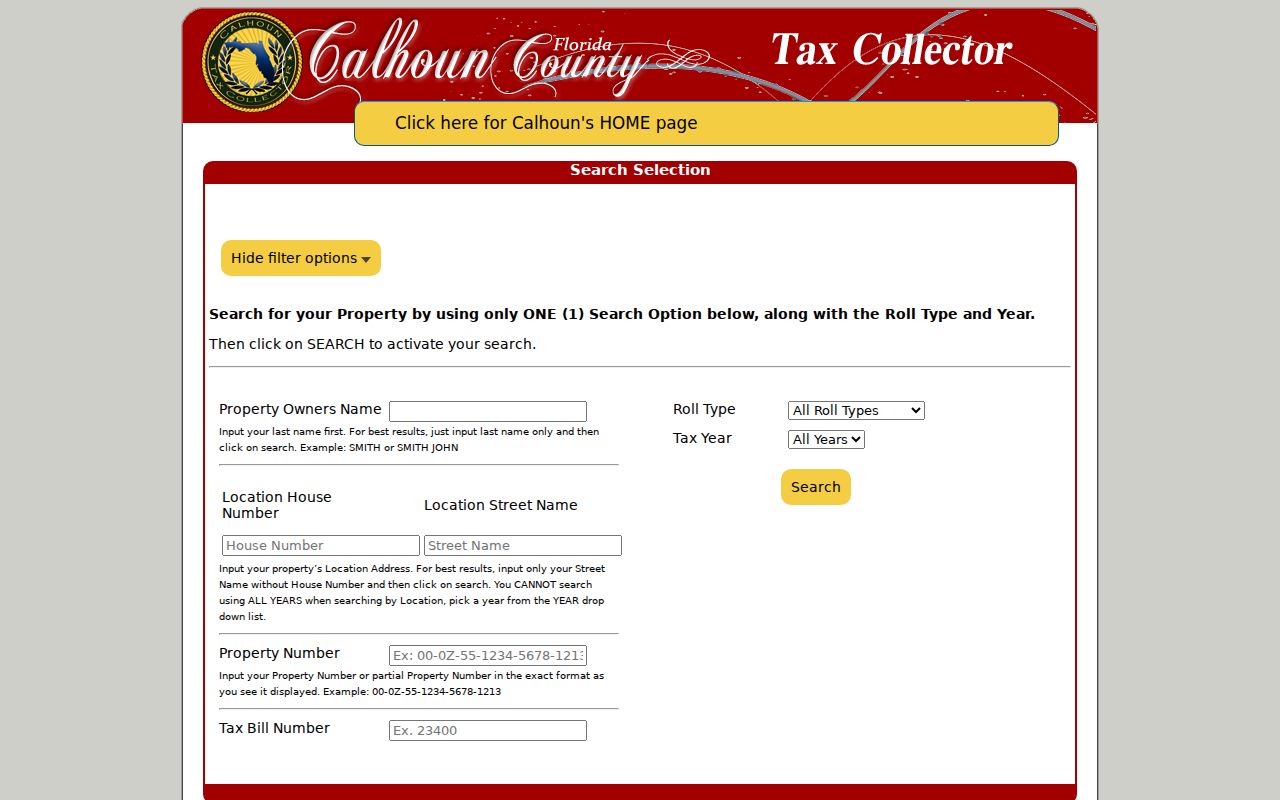
The county property tax form lays out all four search modes on one page, with year and roll controls beside them.
Compare Calhoun County Tax Districts
Revenue lists Anniston district 32 at 51.5 mills. Oxford district 24 and Jacksonville district 53 each total 47.5 mills. Rural north sits at 39 mills and rural south at 40. Fire subcodes can appear too. Rely on the parcel's own district. A postal city name does not prove the corporate boundary. Neighbors can carry different totals from city limits or fire districts. The official bill controls.
Check Calhoun County Tax Exemptions
The homestead affidavit asks for the parcel, physical and mailing addresses, deed reference, deeded owner names, purchase and occupancy dates, and contact facts. Claims based on age, blindness, or permanent disability must be made in person first. Current-use applications run October through December. An exemption changes the taxable result. It does not change title or set a sale price.
Review Calhoun County Reappraisal
Revenue estimates about 70,000 parcels and inspects roughly 25 percent each year. October 1 is the annual effective date. Two parcels on the same roll may have been inspected at different points. A 2025 law caps annual assessed-value increases at seven percent for certain Class II and III property, subject to statutory terms. That cap says nothing about market sale value.
Resolve Calhoun County Tax Name Gaps
The county warns that a bill can stay in a prior owner's name. This can happen after a purchase. Match the parcel, deed reference, and legal description, and verify the latest Probate deed. The Calhoun County property value record explains value terms apart from tax payment. Revenue mail research costs $2 per parcel. Staff will not give values or parcel numbers by phone. Appraisal is 256-241-2870, Assessing is 256-241-2855, and Collections is 256-241-2840.
Audit Calhoun County Value Components
The county field model separates land value, improvement value, total value, and assessed value. Read all four. A structure change moves the improvement side. Acreage and land use shape the land side. Then the class ratio applies. That sequence shows whether a dispute concerns property facts, appraisal judgment, classification, or an exemption. Revenue asks owners to report additions, removals, ownership changes, and corrected mailing information. Photos, surveys, purchase facts, and comparable sales can support a focused review.
Trace Calhoun County Delinquent Tax Records
A delinquent bill can lead to an advertisement, a tax-lien auction, redemption material, or a state land process. Search Revenue first for the bill and its status. County notices come next, and state-held land runs through the Alabama Department of Revenue or the State Land Commissioner. Sheriff sales and mortgage foreclosures answer to different authority. The bill may still name a prior owner. Follow the APN and legal description, and request the actual sale, redemption, or deed record before stating an outcome.
Contact Calhoun County Revenue Offices
Calhoun County keeps its revenue offices at 1702 Noble Street in Anniston. Each unit owns one piece of the property tax record. Appraisal covers land and building facts. Assessing handles class, ownership, mailing addresses, homestead, and current use. Collections deals with bills, interest, and delinquency, and Mapping keeps the parcel framework intact.
Name the parcel and year in any request. Need a conveyance, a recorded lien, or a deed copy? Go to Probate rather than asking tax staff for a title conclusion.
Reconcile Calhoun County Tax Bills
Treat a Calhoun County tax bill as one record. Read the parcel number, roll type, year, owner label, district, value fields, and payment status together. Read them as one set of facts. Never merge two accounts just because a house number or owner name looks off. Instead, search the street, compare PPIN and APN, and inspect the deed reference. Remember that a vacant tract may carry no useful street number.
Keep a dated copy of any result before asking Revenue a question. Online tax and mapping records can shift after a monthly update. They can also shift after a payment, a correction, or an assessment action. The dated copy shows which fields prompted the request.
Prepare Calhoun County Assessment Evidence
The Board of Equalization form rewards a concrete claim. State the value you want and explain why. Attach recent purchase facts where relevant, comparable sales, photos of condition, maps, surveys, or proof that a structure came down or suffered damage. Every item should point to the same parcel.
The appeal addresses assessed property facts and value. It will not settle title, a boundary fight, or a disputed deed. Those questions belong with Probate, a surveyor, a court, or legal counsel as appropriate.
Keep a dated copy of every filing and every response. Those pages preserve the exact values, the tax year, the parcel number, and each piece of evidence the Calhoun County assessor weighed during the review.