
Read Calhoun County Deed Records
The Probate Judge's Recording Division records, indexes, and preserves deeds. It also preserves other permanent land instruments in Calhoun County. A deed names the parties. It also places the conveyed interest of record through a legal description. Mortgages, assignments, liens, judgments, easements, lis pendens, condominium instruments, and plats live in the same recording system. Each serves a different purpose.
| Deed Type | What It Does | Common Use |
|---|---|---|
| Warranty deed | Conveys the stated interest with written warranties. | Ordinary sales. |
| Quitclaim deed | Conveys whatever interest the grantor holds. | Family or interest cleanup. |
| Executor or administrator deed | Conveys estate property under probate authority. | Transfers after death. |
| Foreclosure deed | Records a transfer following foreclosure. | Mortgage enforcement. |
| Tax-related deed | Records an interest from a statutory tax process. | Delinquent property. |
Not every recorded instrument conveys ownership. A mortgage, lien, judgment, or easement may burden the same land while the deed stays in place, so read the instrument itself, because its short label cannot settle its legal effect.
Work the Calhoun County Name Index
Calhoun County offers no public online deed-index form. Start from Revenue's current parcel, its legal description, and the last deed book and page. Then move to the Probate Record Room terminal. Search exact names, variants, entities, trusts, and estates, and make sure each result describes the same land.
- Copy the present parcel's legal description and deed reference.
- Find the present holder's acquisition deed with that party as grantee.
- Read the grantor and all earlier book, page, plat, or estate references.
- Search that grantor as an earlier grantee and repeat.
- Grantor
- The party transferring the stated interest.
- Grantee
- The party receiving the stated interest.
- Chain of title
- The linked sequence of transfers for the same land.
- Book and page
- The local retrieval reference for an instrument or plat.
Order a Calhoun County Deed Copy
The Record Room holds five first-come public terminals, open 8:00 a.m. to 4:30 p.m. on weekdays. Probate sits at 1702 Noble Street, Suite 102, Anniston. Call 256-241-2825. Copies cost $1 per page, and certification adds $3 per document. The county offers no web image service. Mail requests should include a self-addressed stamped envelope, since the office remains the dependable route for an official copy.
Recorded, not guaranteed. Calhoun County deed records show filed instruments, not clear title. Unrecorded interests and disputes require professional review.
Use Calhoun County Record Room Terminals
The county warns that not all records needed for title work are online. Bring the current owner's exact legal name. Add alternate spellings, the APN, the deed reference, a subdivision or section-township-range description, and a rough transfer period. These keys cut false matches. They also help staff locate older books.
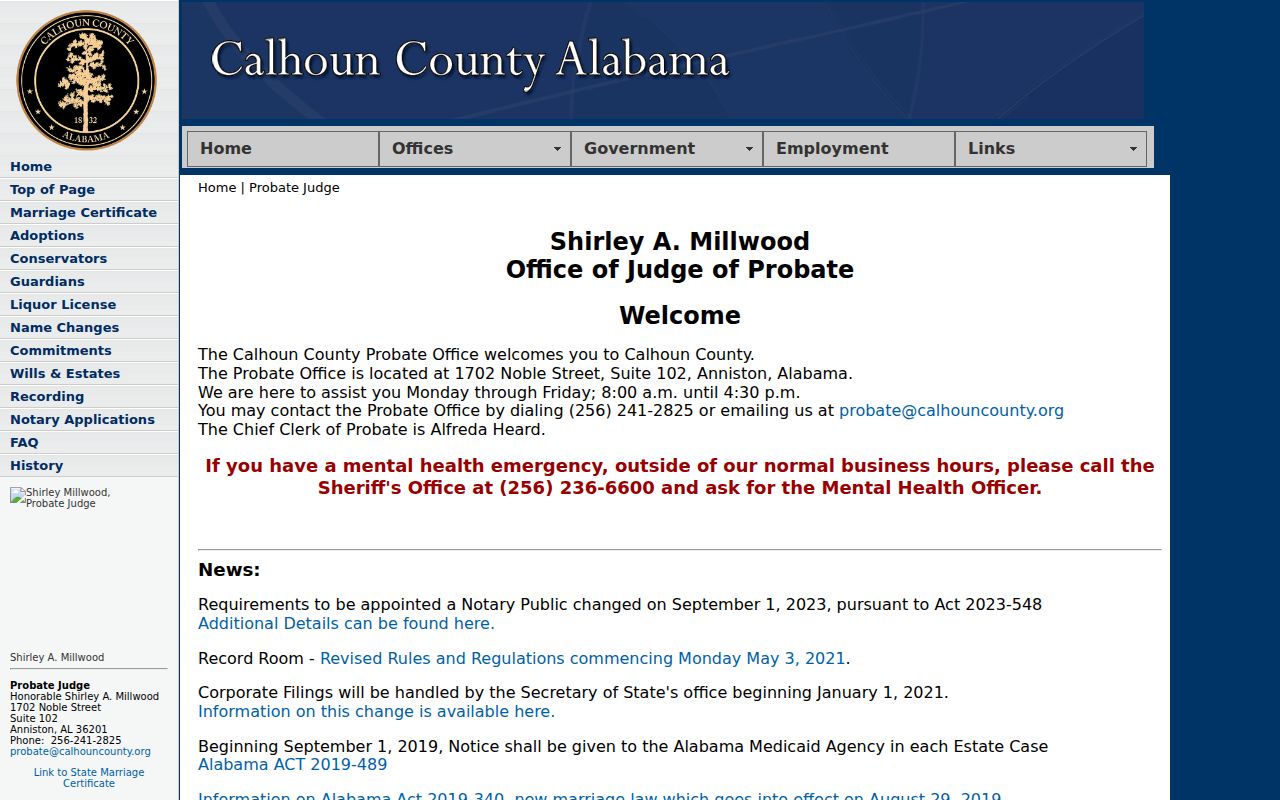
The Calhoun County Probate page lists the instruments on record, the access hours, and the charges, which makes planning an office visit easier.
Check Calhoun County Recording Details
Probate asks for the preparer's name and address, grantor or mortgagor marital status, grantee or mortgagee mailing address, a complete legal description, and signed notarization. The description should cite a plat book or a section, township, and range. Documents must be legible originals or certified copies, and they should not be stapled.
These requirements explain a deed's value. It holds the signed transfer and legal land description. The assessment result merely points toward it.
Review Calhoun County Deed Fees
The current schedule sets $15 for the first recorded page. Each added page costs $3, and extra indexes or references run $1 apiece after two. Deed tax runs $0.50 per $500, rounded up. These recording charges sit apart from the $1-per-page copy cost. The certification charge adds $3. The first-page fee rose on November 1, 2025. Before paying a costly deed-copy solicitation, compare it with the county's own schedule.
Follow Calhoun County Estate Deeds
An owner's death can pause a grantor-grantee trail. Watch for estate, executor, administrator, will, decree, affidavit, or heir wording. These clues often appear on later instruments in Calhoun County property records. The Probate estate file may hold the authority behind a later conveyance. County guidance allows five years to probate a will. An inventory is due within 60 days after appointment. Even so, each case controls its own land trail.
Match the estate party to the parcel. Do not assume the tax roll updates the moment a death or sale occurs. For a longer chain, the former-owner chain process handles a sequence of owners rather than a single copy.
Extend Calhoun County Deed Research
Lot-and-block deeds lean on recorded plats. Probate preserves the plats. Revenue GIS helps place the modern parcel. Older research can continue in the Public Library of Anniston-Calhoun County's Alabama Room, whose holdings include deeds, mortgages, early Circuit Court records, maps, newspapers from 1827 onward, and extensive microfilm. Ask staff about the exact volume or reel, since digital coverage is not complete.
The county seat moved from Jacksonville to Anniston in 1899, so old family notes may point to the earlier courthouse setting. Probate remains the recording custodian.
Cross-Check Calhoun County Encumbrances
The Recording Division admits far more than deeds. Mortgages, deeds of trust, assignments, liens, judgments, easements, lis pendens, bankruptcy orders, contracts that convey real-estate interests, and condominium instruments all pass through it. A current deed alone cannot show whether an encumbrance remains active, so search the party names and land description and follow every assignment and release. A lien or judgment may lead to Circuit Court. A lis pendens signals litigation and should be matched to the case. These checks do not decide priority.
Test Calhoun County Legal Descriptions
Names repeat. Legal descriptions narrow the land instead. Compare the subdivision, lot, block, plat book and page, or section-township-range calls from one deed to the next. Watch for splits, combinations, and rights-of-way. Remember that an address can change without changing the older land description.
One Oxford notice shows the trap. It cites Dodson Street under its older Second Street name. The notice also cites an unrecorded plat and a vacated alley in Deed Book 922, Page 485. Search the description rather than forcing an old address onto a modern map.
Connect Calhoun County Court Deeds
Court cases shape Calhoun County deed records more often than people expect. Foreclosure, quiet title, partition, ejectment, and lien enforcement all leave a mark. Each can produce a case file and, later, a recorded instrument. The Circuit Clerk keeps a public terminal. You can pull the docket there. A written request should name the case, the parties, and the document. Say whether you need a certified copy.
Probate then handles whatever the court put into the land records. That includes deeds, judgments, lis pendens, and releases. Go past the docket label. Ask for the pleading, exhibit, judgment, sale order, or survey that answers the land question. Compare it against the recorded deed. Don't rely on either one alone.
Date Calhoun County Deed References
A Calhoun County tax card may cite the last deed book and page, but the tax roll can lag behind a recent purchase. Timing matters. Note the filing date on the instrument itself and the tax year's effective date. Then check whether a later deed, corrective deed, assignment, release, or court order was filed under either party's name. Monthly GIS map updates add their own timing wrinkle. The newest date is not always the one that controls.
A correction can refer back to an older deed. An easement or restriction may survive several later transfers. So keep every book and page you cite. Reconcile the whole chain before you settle on an owner of record or rely on the tax bill.
Write down the search date too. Log every spelling you tried and each reference you rejected, so a later visit to the recorder or assessor moves faster and no false lead gets repeated.