
Identify a Calhoun County Owner
Finding who owns a property in Calhoun County starts with one street address. Follow the parcel record from there to the owner of record. The county tax roll and GIS map give the fastest public lead. A recorded deed backs it up with stronger proof. The same route works for homes, vacant tracts, and land held by a company, trust, or estate. Search Calhoun County property owner records with patience, though. The tax roll can lag behind a recent sale. A mailing address may not match the land itself. One name can sit on several parcels.
- Enter the house number and street in the county property and tax search. If the exact address misses, try the street name alone.
- Save the owner name, full APN, location, tax year, and any last deed book and page that appears.
- Take those details to the Probate Judge's Recording Division. Confirm the newest grantee at a Record Room terminal.
- If the grantee is a company, match its exact legal name in the Alabama Secretary of State entity search. That identifies the entity, not its beneficial owner.
This approach answers who owns a parcel without crowning one database as final. Revenue records exist for assessment and tax work. Probate records preserve conveyances. The two should agree through the APN, legal description, and deed reference. Calhoun County cautions that tax data may still list a previous owner after a purchase, and the monthly mapping updates can miss a newer in-house change.
Start With Calhoun Property Records
The Revenue Commissioner opens owner and address searching through the county tax and GIS stack. Its tax form takes an owner name. It also accepts a house number and street, a property number, or a tax bill number. Pick one search mode and set the roll type and year. For owner searches, the county suggests leading with a surname. To pull a whole block, leave the house number out. Then search the street name alone.
A public result can tie a parcel to a PPIN and acres. It may also show a street address, city, ZIP, tax district, total value, land and improvement values, assessed value, and a last deed book and page. Treat each field as a matching clue rather than a guarantee. Values and parcel numbers are not given over the phone. But the office helps in person and mails research for $2 per parcel.
Match the Calhoun County Parcel
A street address can change. A postal city name does not prove where the city limits sit. For tying a mapped tax parcel to a deed description, the full APN works better. Calhoun County's published example is 21-03-06-1-005-021.000. Its parts encode the township and range intersection. The next numbers give the township and the section. After that come the quarter section, the map block, and the parcel.
- Owner of record
- The person or entity named in the current public roll or recorded instrument.
- Situs address
- The physical location used by GIS, 911, and most property searches.
- Mailing address
- The tax correspondence address; it may be outside the county and is not proof of occupancy.
- Title
- The legal ownership interest. A database name alone is not a title conclusion.
When an address and APN clash, weigh the legal description and deed reference first. Splits and combinations can generate a new parcel number. Platted land may also demand its lot, block, subdivision, and plat book details.
Calhoun County Ownership Sources
Three county sources each play a distinct role in a property owner check. The tax roll brings speed. The GIS map settles geography. The recorded deed proves the conveyance itself. Calhoun County publishes no online deed-index form or cutoff year, so the in-person route stays central to a complete ownership search.
| Where Ownership Is Shown | What It Gives | How Current |
|---|---|---|
| Revenue tax roll | Owner name, parcel key, location, values, tax context | Current tax roll; recent sales may lag |
| Probate deed record | Grantor, grantee, legal description, recording reference | As of the newest recorded instrument found |
| County GIS | Mapped tax parcel, APN, address context | Online data updates monthly |
The named owner may be an LLC, a trust, an estate, or several co-owners. That owner need not live at the address. A life estate or joint deed sometimes takes close reading. When estate, executor, administrator, or will wording shows up, the Probate estate file may explain how the land moved before the next deed was recorded.
Confirm the Calhoun County Grantee
The Probate Judge serves as Calhoun County's recorder. Its Recording Division preserves deeds, mortgages, liens, judgments, plats, easements, assignments, lis pendens, and other land instruments. The Record Room holds five public computer terminals. They are open first come, first served from 8:00 a.m. to 4:30 p.m. on weekdays.
Bring the owner spelling, APN, legal description, and a book/page lead. Search grantor and grantee spellings alike, including entity and estate variants. Compare the land description in the newest deed against the Revenue parcel. Plain copies run $1 per page. Certification costs $3 per document, fees separate from recording charges.
The official Calhoun Probate page displays the office and recording information for this step.
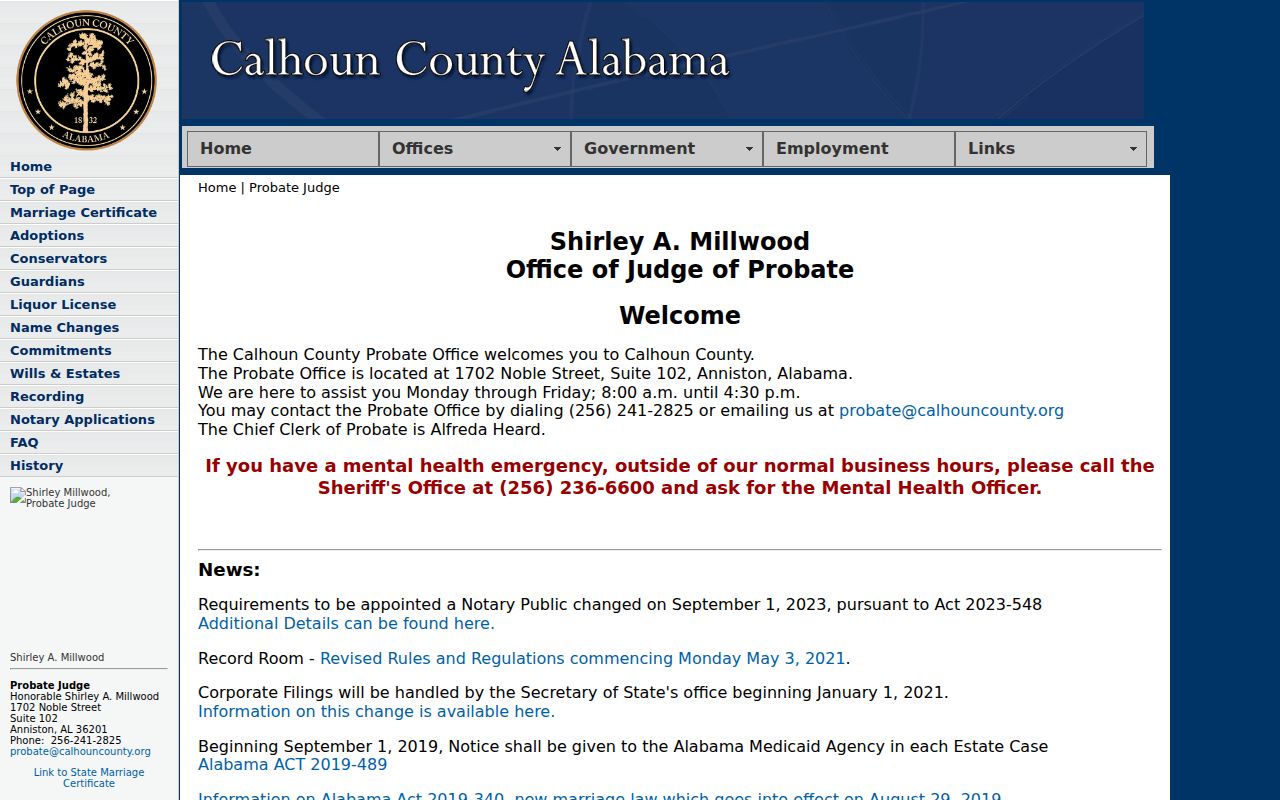
The office page supports the offline check whenever a web property owner result falls short.
Read Calhoun Entity Owner Names
Search the legal grantee exactly as recorded. An individual may appear with initials, a spouse, or a suffix. A trust can be indexed under its trustee. It may also appear under its full trust style. An estate may surface under the decedent, personal representative, administrator, or executor. Business land often sits in the name of an LLC or corporation. The people behind it stay off the deed.
The Alabama business entity search works by entity name or entity number. It also works by officer, agent, and incorporator. It helps separate legal names and surface state filings. It cannot show that an officer personally owns the real estate. For that link, return to the deed and parcel description.
Note: Name variations are only leads; the APN, legal description, and newest deed give the stronger match for a Calhoun County parcel.
Check Recent Calhoun County Sales
The tax roll lags behind a fresh deed. Recording, assessment, and online publication happen as separate steps in Calhoun County. New owners are asked to record and assess the property, and the county warns that a tax bill can stay in the former owner's name. Web mapping and tax data refresh monthly.
After a closing, work from the deed. Confirm its recording date and the grantee named there. Then ask the Revenue office whether its in-house record differs from the public display. No standard lag figure is published. The newest recorded deed is the better evidence.
Limits of Calhoun Owner Lookups
Calhoun County owner records support lawful research, boundary checks, house history, and transaction review. They have limits. They cannot prove occupancy or replace a survey. A mapped parcel line is only tax reference data; no lookup settles a disputed interest; protected information can be withheld under a specific law; and military discharges fall outside Probate's general public-record statement.
Not a title search. A tax-roll owner name is a lead, not proof of title. An LLC, trust, estate, unrecorded interest, or recent deed can require review by the custodian and a qualified title professional.
Alabama's Open Records Law opens public writings to citizens unless an exception applies, but access never authorizes stalking, harassment, threats, trespass, impersonation, or misuse of protected data. Access is not a weapon. A court, not a lookup, settles contested title.